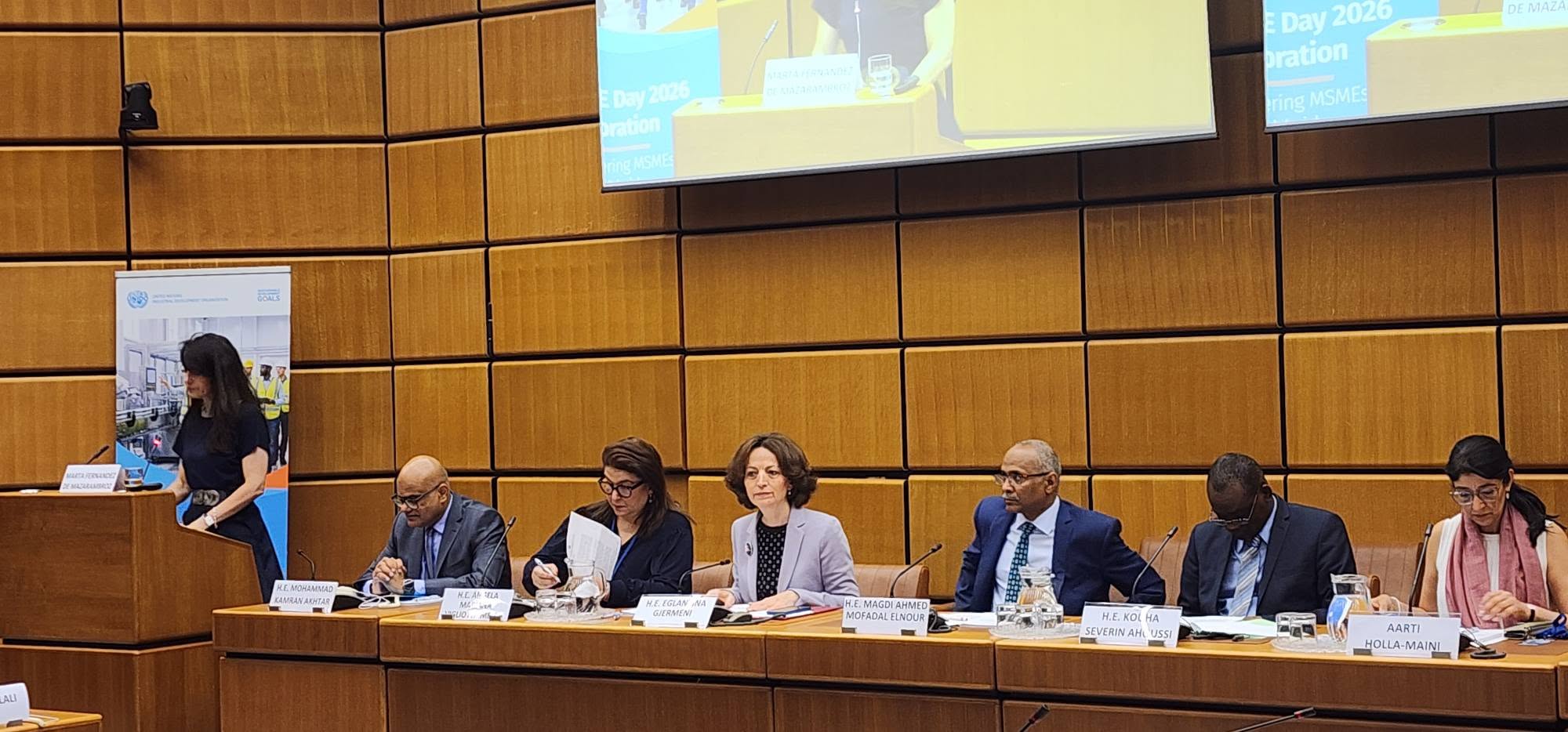



Përfaqësuesja e Përhershme dhe Ambasadorja e Republikës së Shqipërisë Eglantina Gjermeni, foli në panelin hapës për të shënuar Ditën e Kombeve të Bashkuara për ndërmarrjet e mesme dhe të vogla, organizuar nga Organizata e Kombeve të Bashkuara për Zhvillim Industrial, UNIDO, në Vjenë.
Fjala e plotë:
Remarks of the Permanent Representative of Albania, Ambassador Eglantina Gjermeni,
UN MSME Day 2026 Celebration, 09:30, 25 June 2026
Excellencies, distinguished guests, ladies and gentlemen,
It is a pleasure to join you today in celebrating United Nations MSME Day and to recognize the indispensable contribution of micro, small and medium-sized enterprises to sustainable development, innovation and economic resilience around the world.
I would like to thank UNIDO for organizing this event and for its continued leadership in advancing inclusive and sustainable industrial development.
MSMEs are the backbone of our economies. They account for around 90 per cent of businesses worldwide and generate more than 70 per cent of global employment. Beyond these impressive figures, they are drivers of entrepreneurship, innovation, local development and social cohesion.
As industries undergo profound transformations driven by digitalization, artificial intelligence, technological innovation and the imperative of sustainability, MSMEs must remain at the centre of these transitions. The future of industry will depend not only on technological progress, but also on our ability to ensure that smaller enterprises can access, adapt and benefit from these changes.
Allow me also to underline the important link between MSME development and gender equality. Women’s entrepreneurship and the full participation of women in economic life are essential drivers of sustainable and inclusive growth. Yet women-owned and women-led enterprises continue to face disproportionate barriers in access to finance, technology, markets, and business networks. Addressing these challenges is not only a matter of fairness; it is an economic imperative. Empowering women entrepreneurs strengthens productivity, fosters innovation, creates jobs, and contributes to more resilient communities.
For Albania, today discussion is particularly relevant. We are, in many ways, an MSME economy. More than 80 per cent of employed people in Albania work in small and medium-sized enterprises, making them a cornerstone of our economic development. This is the highest rate in the Western Balkans, exceeding the European Union average of 64.5%.
Over the past decade, Albania has focused on strengthening economic governance and formalization. We now look ahead to a new phase focused on productivity, innovation, competitiveness and modern industrial development. Likewise, green transition and energy diversification are increasingly shaping Albania’s industrial outlook, alongside agro-processing and sustainable tourism value chains. Our priorities include accelerating digital transformation, improving access to finance, strengthening managerial and technical capacities, and integrating Albanian enterprises more deeply into European and global value chains.
In this regard, we are particularly grateful for UNIDO’s support in finalizing Albania’s Country Diagnostic for Industrial Development. This important exercise provides a comprehensive assessment of our industrial landscape and will serve as the foundation for the forthcoming Programme for Country Partnership, which will guide Albania’s industrial transformation and support our efforts to meet the standards and requirements of European Union integration.
The diagnostic confirms the central role of SMEs in Albania’s economy. More than 92 per cent of manufacturing firms are SMEs, and they account for over 80 per cent of exporting manufacturing enterprises. The sectors that drive manufacturing employment and exports – such as apparel, leather and footwear, food processing and light manufacturing – are sectors where SMEs play a dominant role and where investments in technology, quality standards, innovation and skills can yield significant results.
At the same time, the findings remind us that important challenges remain. For example, manufacturing still accounts for only around 6% of GDP and business activity remains concentrated in a few regions – such as the capital Tirana, and Durrës and Vlora, so the future of industries must also mean more balanced, inclusive territorial development. Productivity must improve, competitiveness must be strengthened, and enterprises must be better equipped to respond to rapidly evolving market demands.
Albania remains committed to advancing gender equality and supporting women-led businesses through policies and initiatives that promote equal opportunities, economic participation, and entrepreneurship. We believe that strengthening women-owned MSMEs is a powerful pathway towards achieving the Sustainable Development Goals and ensuring that no one is left behind.
For Albania, supporting SMEs is therefore not only an economic and business objective. European Union accession and participation in the Single Market require strong standards, certification, traceability, conformity assessment, energy efficiency, skills and access to finance. Supporting SMEs is therefore also about Albania’s sustainable industrial transformation, export competitiveness and European convergence.
No country can achieve these goals alone. International co-operation, knowledge-sharing and partnerships remain essential. Albania highly values its co-operation with UNIDO, including through initiatives such as the Global Quality and Standards Programme and other projects that contribute directly to strengthening competitiveness and sustainable industrial development.
Events such as today’s provide an important platform to exchange experiences, build partnerships and translate national ambitions into collective progress.
Albania looks forward to further strengthening its co-operation with UNIDO and partners present today, as we work together to empower MSMEs as engines of innovation, sustainable industrialization and shared prosperity. Thank you!