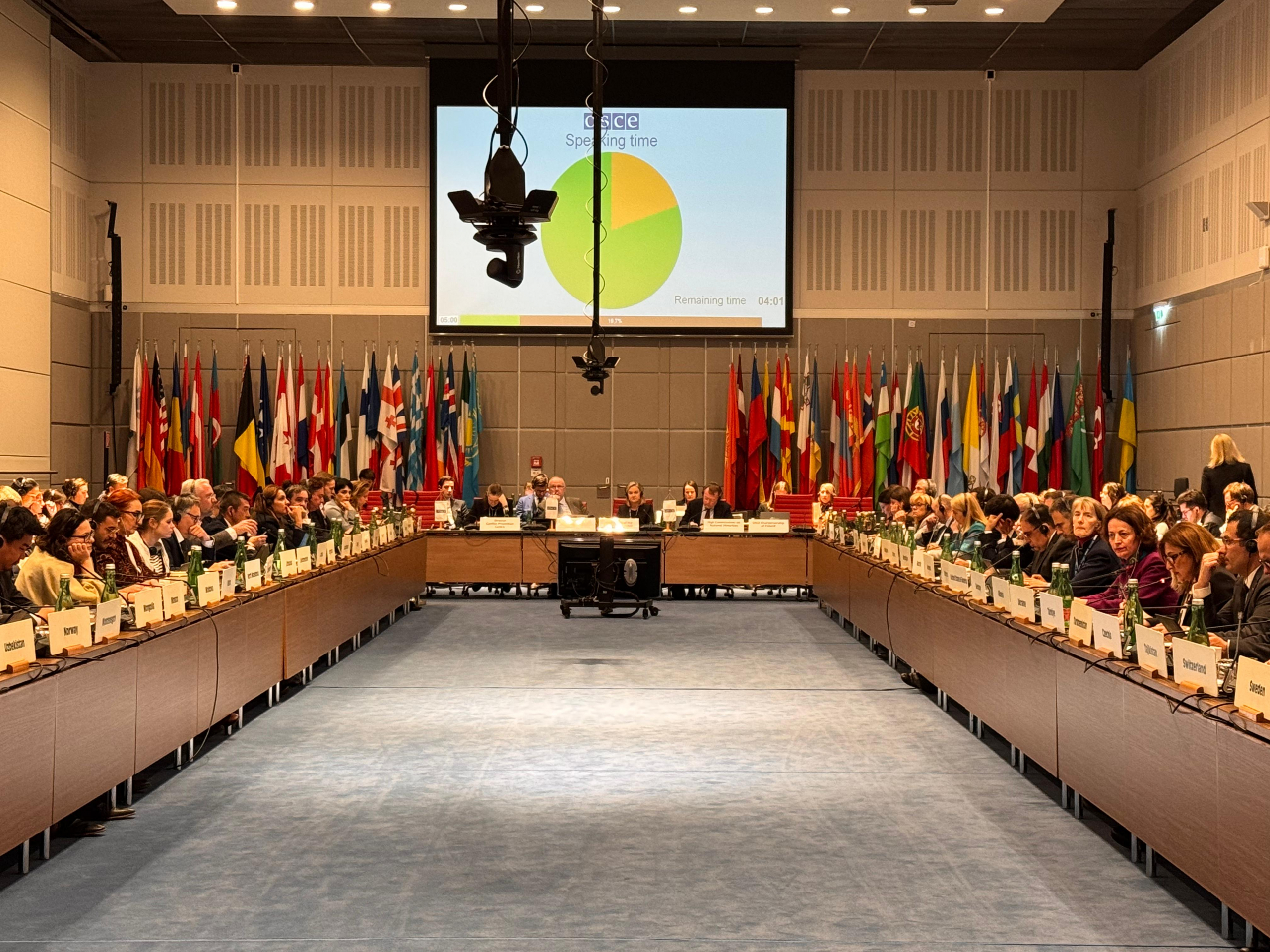



Statement by H.E. Eglantina Gjermeni Ambassador, Permanent Representative
1540th PC, agenda item: Address by the High Commissioner on National Minorities, Mr. Christophe Kamp
Thank you, Madam Chair,
We thank High Commissioner Kamp for his comprehensive address and for the continued dedication of his Office to promoting dialogue, inclusion, and conflict prevention across the OSCE area.
Mr. High Commissioner, dear Christophe,
We have taken note of your report and recent visits, and we appreciate the continued engagement of your Office throughout the region. Albania attaches great importance to your mandate and to the principles it embodies – namely, early warning, depoliticization of minority issues, and the fostering of trust between communities.
We welcome your efforts to engage constructively with Kazakhstan, Kosova and Serbia, to promote practical approaches that strengthen social cohesion and inclusive governance. We also share your view that minority issues should never be instrumentalized for political purposes.
In this regard, allow me to draw your attention to a number of concrete and sustained efforts undertaken by Kosova’s institutions to foster inclusion and improve conditions for all communities. These efforts include the launch of a special employment programme in the four northern municipalities; the recruitment of nearly 200 Serb cadets into the Kosova Police over the past three years; and the allocation of more than €11 million for capital projects in Serb-majority areas during 2024.
With a new legal framework in place, targeted job vacancies have also been announced exclusively for members of non-majority communities across several ministries — including Defence, Internal Affairs, Communities and Returns, Regional Development, and the Office of the Prime Minister. These measures, together with the continued engagement of civil society and community representatives, reflect Kosova’s solid legal framework, its commitment to multi-ethnic governance, and its alignment with the OSCE’s founding principles.
However, the activities of certain political segments in Belgrade, which continue to artificially incite tensions by instrumentalizing the Serb community in Kosova, remain a cause for concern. Such actions serve neither the interests of the Serb community in Kosova nor the normalization of relations between the two states.
We firmly believe that the Serb community in Kosova should and could fully exercise the rights guaranteed by the Constitution of the Republic of Kosova and actively participate in the public and political life of the country.
Mr. High Commissioner,
We would like to draw your attention to the situation of the Albanian community in the Presheva Valley, who continue to face serious and long-standing challenges, and we strongly suggest that you to meet with their representatives during your net visit in Serbia.
Albania notes with concern the situation of persons belonging to the Albanian national minority in Serbia, particularly in the municipalities of Presheva, Bujanoc, and Medvegja. As also highlighted by the Advisory Committee on the Framework Convention for the Protection of National Minorities (FCNM), Report on Serbia, May 2025, members of this community continue to face challenges in the effective enjoyment of their rights.
Limited access to public services, underrepresentation in state institutions, and obstacles to the recognition of diplomas continue to hinder their full participation and inclusion. Furthermore, insufficient investment and development in southern Serbia, together with inconsistent implementation of the right to use the Albanian language and national symbols, contribute to economic disparities and social exclusion.
Of even greater concern is the ongoing “passivisation” of addresses and deregistration from the civil registry, which effectively strips many individuals of their citizenship status and prevents them from exercising fundamental rights, including property ownership, access to social services, and participation in political life.
To give just one example, according to an official response from the Leskovac Police Directorate, dated 13 April 2020, and held in the archives of the Youth Initiative for Human Rights (YIHR Serbia), a total of 4,174 addresses of Albanian citizens were passivized in the municipality of Medvegja alone. The result of these policies amounts to a silent demographic engineering of the Presheva Valley—gradually diminishing the presence, rights, and electoral influence of the Albanian community. What is presented as technical bureaucracy has, in fact, profound political and cultural implications.
Mr. High Commissioner,
We encourage your Office to continue paying close attention to these matters and to engage with the relevant authorities in Serbia, consistent with your conflict-prevention mandate and guided by the Bolzano/Bozen Recommendations, which underline the responsibility of States for the protection of minorities within their own borders
Addressing these challenges in a constructive and balanced manner would contribute not only to improving the situation of the Albanian community but also to strengthening inter-ethnic trust and regional stability as a whole.
Domestically, Albania remains firmly committed to strengthening the protection of minority rights, in line with its long-standing values and international obligations. Last year, Albania adopted the final set of implementing legislation under the Law on National Minorities, addressing two key areas: the right to free self-identification and the use of minority languages in public life. This represents an important milestone toward greater inclusion, participation, and protection of all minority communities in the country. Albania will continue working to ensure the full and effective implementation of this legal framework, guided by the OSCE’s core principles and the recommendations of the High Commissioner on National Minorities.
In conclusion, Albania reiterates its full support for your mission, High Commissioner, and encourages continued, effective, and balanced engagement across the region, aimed at ensuring equal protection for all communities and consolidating inclusive, multi-ethnic societies, consistent with the founding principles of the OSCE.
Thank you!