



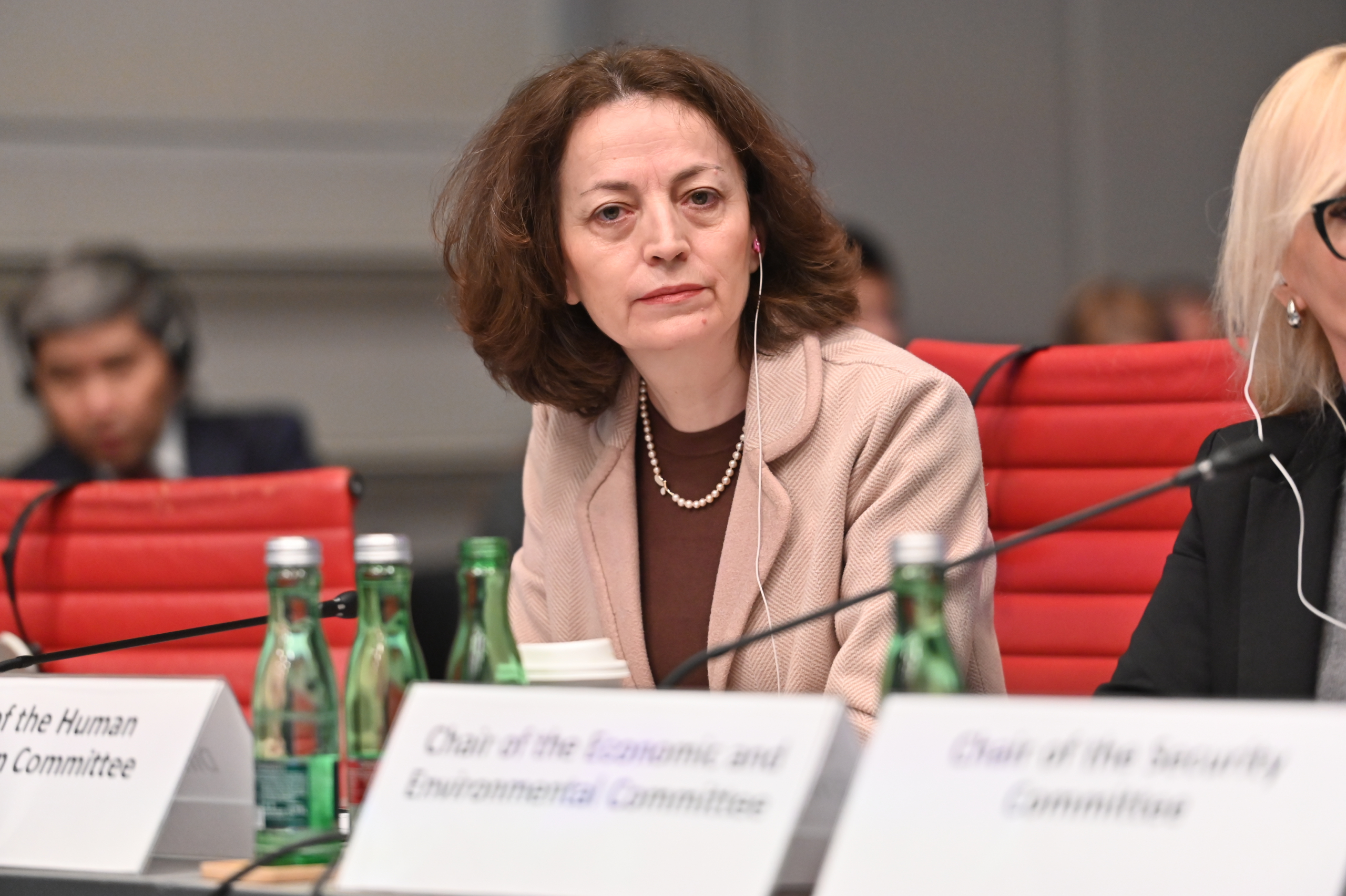
Presentation by the Albanian Chairperson of the OSCE Human Dimension Committee
OSCE Permanent Council, 12 February 2026
Thank you, Raphael.
Colleagues, I am honoured to brief the Permanent Council as Chair of the Human Dimension Committee.
I am grateful to the Swiss Chairpersonship for the confidence placed in Albania, and in me personally, and I would also like to acknowledge the work of our predecessors, Sweden, Ireland, and Norway, who guided this Committee with restraint and resolve through exceptionally difficult years.
I would also like to welcome the Conference on Combating Anti-Semitism, held in St Gallen on 9-10 February. Thank you to Swish Chairpersonship for the excellent organization, and for the impressive hospitality.
The Human Dimension Committee has never been an easy chair to hold. Today, it is particularly demanding. We meet at a time when human rights and fundamental freedoms are increasingly contested, and when principles that once united this Organization are openly challenged.
The Committee sits at the heart of the OSCE’s comprehensive concept of security.
It is where we assess how commitments on human rights, democracy, the rule of law, and fundamental freedoms are implemented in practice.
These commitments, rooted in the Helsinki Final Act, are not historical references. They remain our shared operating framework and, in times of strain, our anchor.
Albania’s programme is firmly aligned with the priorities of the Swiss Chairpersonship, under the banner of dialogue, trust, and security. Our objective is clear: to keep the Committee credible, inclusive, and focused on implementation.
The programme was developed following consultations with all participating States, with ODIHR, RFoM, HCNM, the Secretariat, and civil society.
These exchanges informed both the thematic focus and the working methods we propose for the year.
Thematic discussions in 2026 will address gender equality, with a focus on political representation; the rule of law; elections in the digital age; tolerance and non-discrimination, including religious tolerance; freedom of expression; national minorities; and violence against women.
Gender, youth, and education will be treated as cross-cutting elements throughout the year. A joint cross-dimensional meeting of the three Committees on anticipating technologies is also foreseen.
I am conscious that delegations may have views on themes that are included, as well as on those that are not.
The reality is that the Committee cannot meet every week, nor can it do justice to every aspect of the human dimension within a single annual programme.
In this regard, some issues will also be taken forward in other formats, including the possible HDIM (Human Dimension Implementation Meeting) and SHDMs (Supplementary Human Dimension Meetings).
At the same time, we have designed our sessions in a way that allows every participating State to bring its perspectives, experiences, and national positions into the Committee’s work. The structure of meetings will ensure space for delegation-led interventions and exchange.
Cooperation with the United Nations and the Council of Europe will continue, with a view to strengthening complementarity and avoiding duplication.
Last but certainly not the least, we will also maintain a standing focus on the human dimension implications of Russia’s war of aggression against Ukraine.
The scale of human rights violations and humanitarian consequences requires sustained attention within the HDC, in line with our mandates and commitments.
In my role as Chair, I do not see my task as arbitrating political positions or promoting national views. My responsibility is to enable dialogue, ensure fairness, and keep space open, including when disagreement is sharp and trust is fragile.
As I mentioned earlier, meetings will be structured to maximise participation by delegations. Briefers will be limited and selected to inform discussion rather than replace it. OSCE institutions and field operations will be closely involved, to keep our exchanges grounded in reality and focused on implementation.
We will maintain the standing agenda item on voluntary reporting, which we see as a constructive, non-politicised tool for peer exchange and shared learning. It is often through concrete national experiences that trust is rebuilt and understanding deepened.
The Human Dimension Committee cannot resolve the divisions we see around this table. But it can prevent disengagement. It can keep commitments visible, dialogue alive, and the human dimension at the centre of our work.
That is the purpose with which Albania approaches this responsibility.
Thank you.
Additional remarks at closing
Dear colleagues,
I am grateful for the views, support, feedback and suggestions expressed today. They confirm both the diversity of perspectives around this table, and the importance delegations attach to the work of the Human Dimension Committee.
I am under no illusion that chairing this Committee means navigating 57 different priorities, sensitivities, and expectations. Disagreement is part of our reality. But so is a shared responsibility to ensure that dialogue does not erode and that our commitments do not fade into abstraction.
The programme before you sets out a framework for our work in 2026. It is not static. It will remain under review and may be adjusted by the Chair in light of developments, including through the convening of additional special or informal meetings, where this would add value.
I look forward to working with all of you to ensure that the Human Dimension Committee remains a space where commitments are examined seriously, dialogue is preserved, and participation is meaningful.
Thank you.