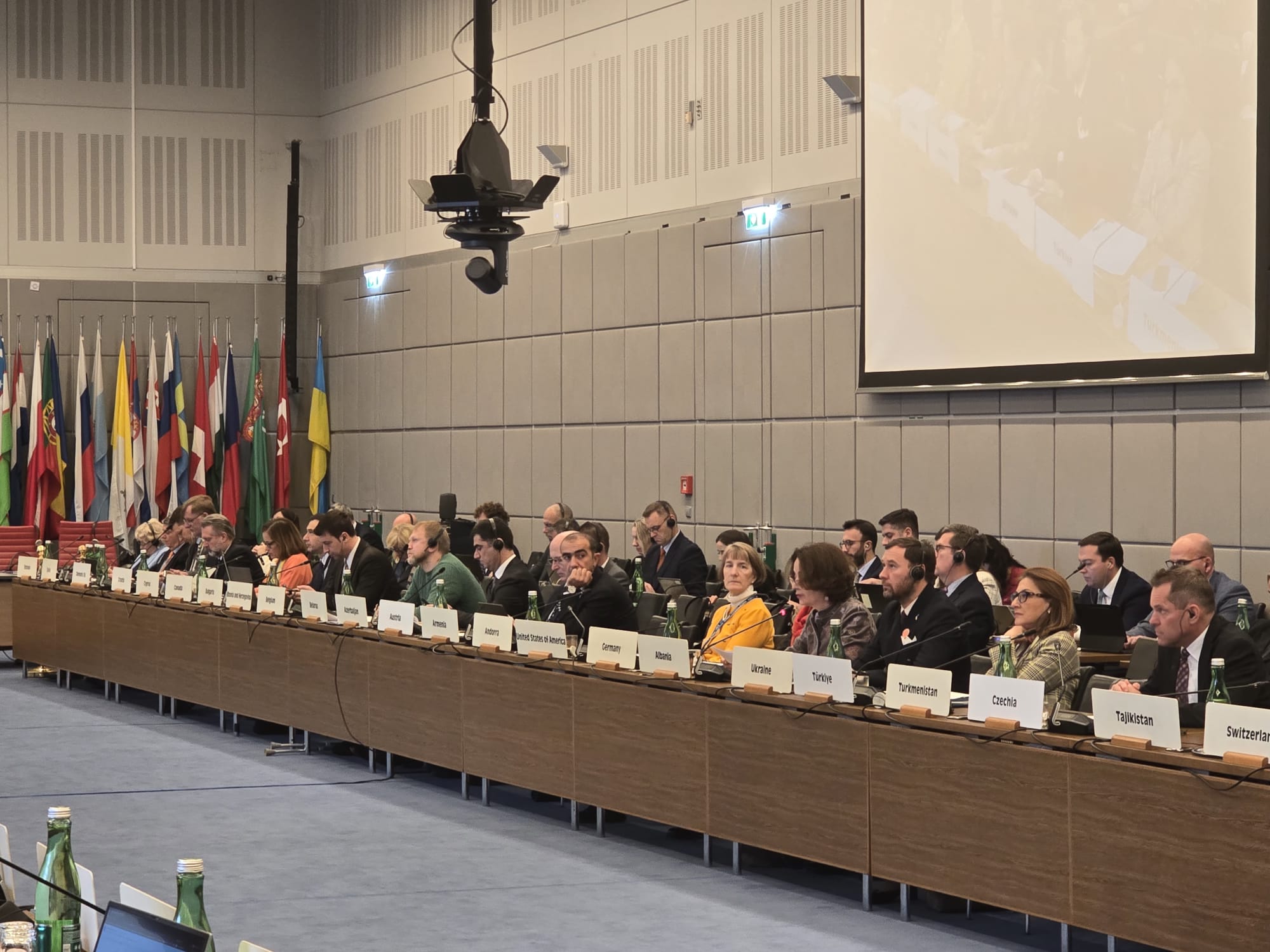



Statement by H.E. Eglantina Gjermeni, Ambassador, Permanent Representative
Joint Meeting of the Forum for Security Co-operation and the Permanent Council
Security Dialogue “Helsinki Final Act 50 Years” Wednesday, 26 November 2025, Vienna,
Thank you, Mr. Chair,
Albania wishes to sincerely thank Finland for its leadership as Chair of both the FSC and the Permanent Council, and for convening today’s discussion. We also express our appreciation to the distinguished panelists for their valuable insights and contributions.
Nearly fifty years after its signing, the Helsinki Final Act remains one of the clearest expressions of what Europe once agreed security should look like: borders respected, people protected, and states accountable.
Across many regions, societies are grappling with complex challenges related to migration, mobility, and demographic change. These trends underscore how essential it is to uphold the human-centred spirit of Helsinki, ensuring that even as we address modern pressures, we do so in a way that reflects our shared values and commitments.
Albania’s relationship with the Helsinki process is distinct, but our commitment is clear. We stand among the strong supporters of Ukraine’s just fight for freedom, dignity, and the right to exist as a sovereign nation. For us, this is not an act of charity; it is a matter of principle, and of future European security.
If we want Helsinki to speak to the next generation, to Gen Z and those that will follow, we cannot rely on nostalgia. They do not remember the Cold War. They remember pandemics, disinformation, and cyberattacks. They live in algorithmic realities where facts compete with manipulation. They face a world where climate, technology, and migration are inseparable from security.
What does the Helsinki Final Act mean to them?
And what will it mean ten years from now, when they judge whether we acted or merely commemorated?
To remain relevant, the Helsinki framework must confront today’s frontiers.
First, emerging technologies such as artificial intelligence, big data, and autonomous systems are transforming conflict faster than our institutions are adapting. The principles of transparency, responsibility, and restraint must apply equally in cyberspace and in the evolving digital battlefield.
Second, hybrid threats continue to blur the line between influence and interference, and the Helsinki emphasis on confidence and openness must evolve to counter these challenges.
Third, gender equality is not “done.” Progress is fragile, and regression is real. Inclusive security is not an aspiration; it is a requirement for resilience.
Fourth, human rights and fundamental freedoms remain the backbone of any credible security architecture. When they erode, instability follows, always.
Finally, the movement of people must be managed with humanity and grounded in international law. Fear cannot guide us. Values must.
The OSCE, born from the same logic as the Helsinki Final Act, is now expected to operate in a world very different from the one that created it. Yet its core purpose has not changed: to reduce the risks of conflict through cooperation, transparency, and accountability.
The question is not whether the Helsinki principles still matter. The question is whether we, collectively, still have the political courage to apply them.
Ukraine today is the most consequential test of that courage. If Helsinki means anything in 2025, it begins with defending the sovereignty and territorial integrity of a participating State under attack. It begins with ensuring that aggression brings consequences, not rewards. It begins with supporting Ukraine until justice and peace are restored.
If we fail there, we fail the entire logic of Helsinki.
Our task is not to celebrate the past; it is to secure the future. A future in which a new generation will know that, when the principles of the Helsinki Final Act were challenged, we defended them with clarity, conviction, and unity.
Thank you.