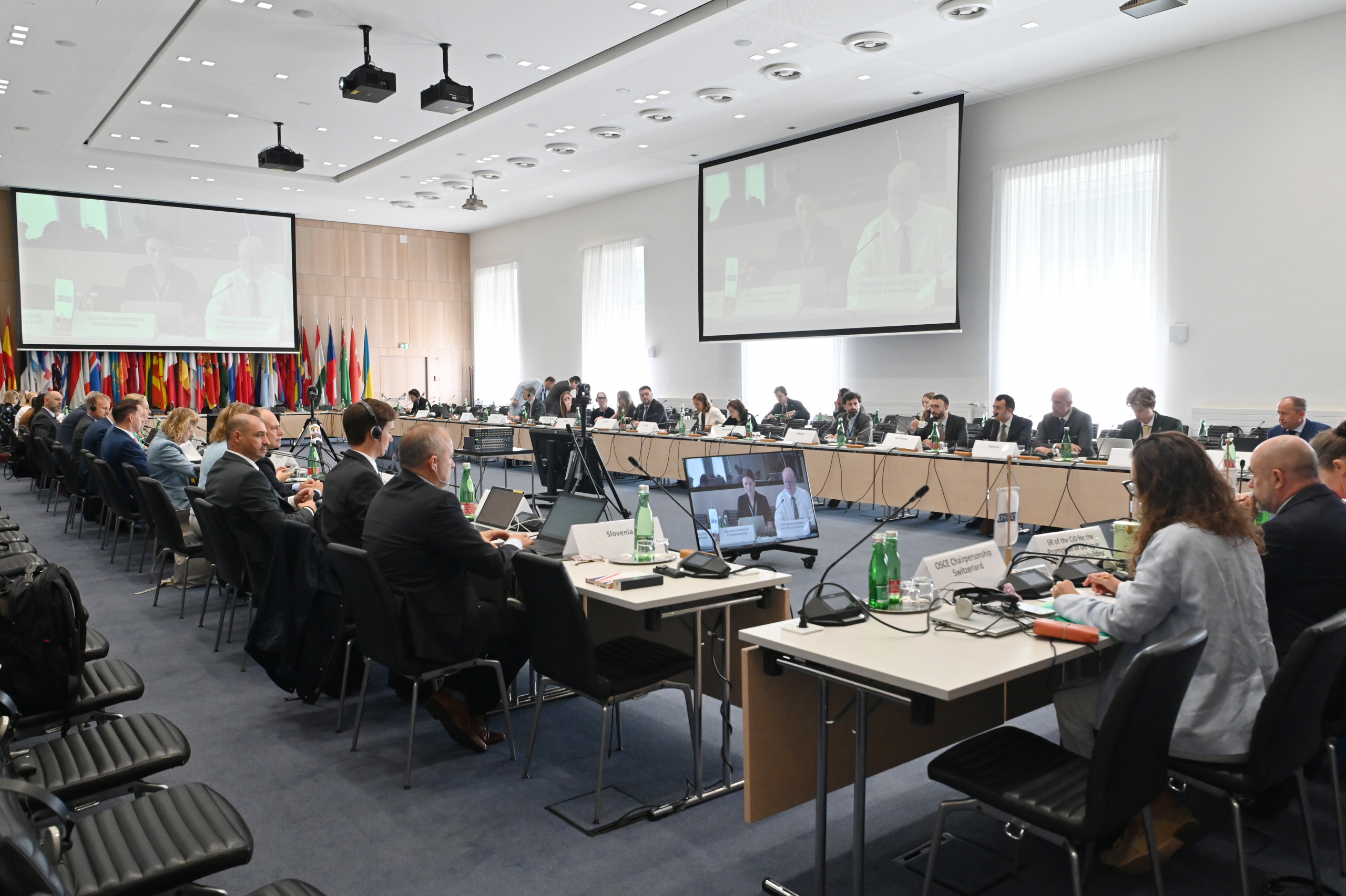



Remarks of Albania at the OSCE Security Committee
“Three decades after conflict: experiences and insights in post-conflict rehabilitation in South-Eastern Europe”
Vienna, 10:00, 15 September 2026
Thank you, Mr. Chair, Ambassador Holland,
Firstly, we thank you and the UK team for the steady chairing of the Security Committee, and for the thorough preparation of this meeting, dedicated to a topic that is both timeless and timely. We highly appreciate the insights, experiences and examples shared by the panellists today.
Albania attaches great importance to playing its part in preserving and furthering the immense progress that the region of South-East Europe has marked in the last decades.
For my country, the experience of South-Eastern Europe demonstrates that post-conflict rehabilitation is fundamentally a security issue. Sustainable peace requires more than ending violence. It requires addressing the drivers of conflict, strengthening institutions, rebuilding trust, and ensuring that unresolved security challenges do not become sources of renewed tensions.
The consequences of conflict and the subsequent recovery efforts cut across the three dimensions of the OSCE. While are focus today is naturally on the first dimension, we should not lose sight of the security consequences of unresolved conflict legacies.
Missing persons, unresolved disputes, weak institutions, and organised crime can continue to affect stability long after the end of hostilities. Addressing these issues therefore contributes directly to preventing renewed conflict and strengthening regional security.
As we look back, we see how the conflicts in Western Balkans did not occur overnight. They were fuelled by years of nationalistic behaviour, divisive rhetoric and false narratives. Today, sadly, we continue to witness glorification of convicted war criminals, the denial of genocide and historical revisionism. If left unchecked, these tendencies risk deepening divisions and undermining regional stability.
Albania firmly believes that genuine peace, security and reconciliation can only be built on truth, accountability, respect for victims and survivors, and a shared commitment to ensuring that the crimes of the past are never repeated.
Nowadays, whenever we speak of war and conflict, but also resilience, in the OSCE region, our thoughts certainly turn to Ukraine. The resilience of the Ukrainian people and institutions demonstrates the importance of national ownership, strong institutions and international solidarity in confronting prolonged security challenges.
The experience of our region can offer valuable perspectives – not as a model to be replicated, but as a body of practical insights that can help the OSCE remain relevant to the security challenges of today and tomorrow.
This meeting reminded us of some important truths: contexts are not identical; lessons cannot be transferred mechanically; local ownership is essential; Western Balkan actors have expertise and agency; Ukraine’s own resilience and agency generates new insights relevant to the security in the region and the wider OSCE area.
The positive and longstanding legacy of the OSCE in the Western Balkans has shown the importance of sustained engagement, including when the immediate security crisis has passed.
In this vein, we express our firm support and confidence in the work of the Conflict Prevention Centre, the Transnational Threats Department, and the OSCE field operations, which are closest to the people and well placed to translate the Organization’s commitments into practical security support. Thank you!